

Photographing the Aurora Borealis and Aurora Australis
To successfully photograph the aurora, you need to look past the “general forecast” and understand real-time space weather. Think of the Kp Index as your “long-range weather forecast” and the Bz and Speed as your “immediate radar.”
1. The “Big Picture”: Kp Index
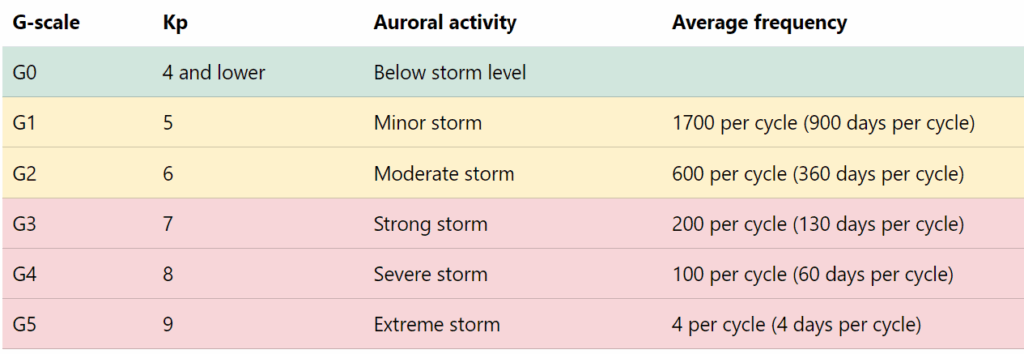
The Kp Index is a scale from 0 to 9 that measures geomagnetic activity. It tells you how far south (or north in the Southern Hemisphere) the aurora might reach.
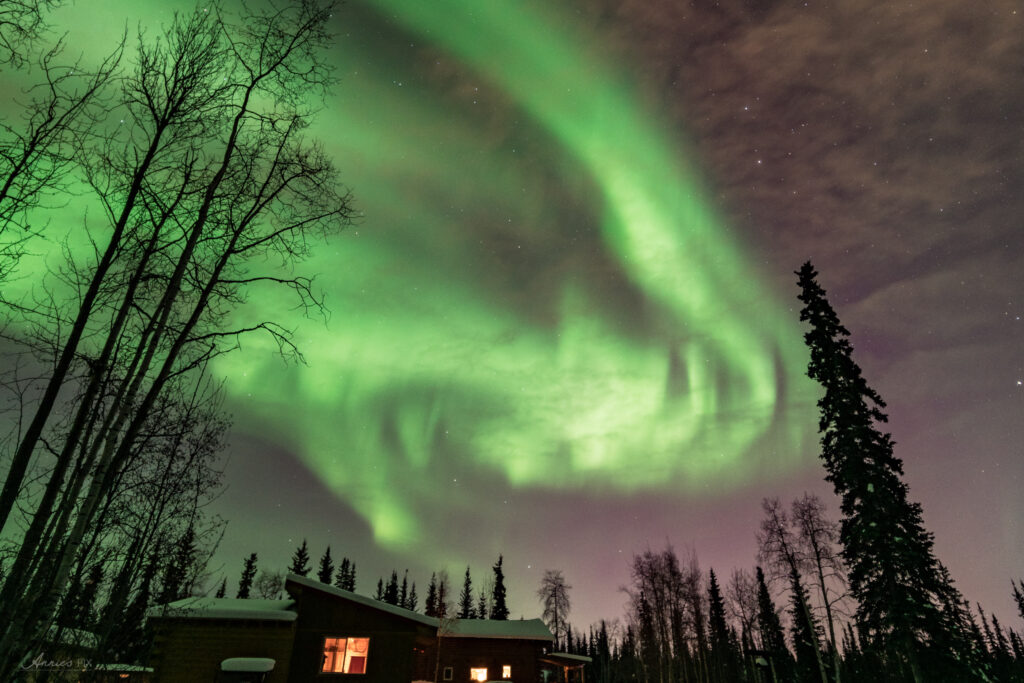
Tip: Don’t wait for a Kp 5. If you are in a high-latitude place like Iceland or Alaska, you can get incredible photos at Kp 2.
Kp Levels Explained:
- Kp 0-2: Calm. Auroras are faint and only visible very close to the poles.
- Kp 3-4: Minor activity. Auroras become brighter and visible at higher latitudes (e.g., northern US/UK).
- Kp 5: Geomagnetic Storm (G1-level). Auroras can be seen further from the poles, with potential minor impacts on satellites/GPS.
- Kp 6-7: Strong Geomagnetic Storm (G2-G3). Auroras visible from lower latitudes (e.g., northern US states), with increased risk of satellite/radio interference.
- Kp 8-9: Severe to Extreme Geomagnetic Storm (G4-G5). Very bright, widespread, and active auroras visible from low latitudes (even the southern US), with significant risk to technology.
2. The “Trigger”: Bz (The Secret Ingredient)
Even with a high Kp, you might see nothing if the Bz isn’t right. The Bz is the direction of the magnetic field.
- Positive (+) Bz: The “door” to Earth’s atmosphere is closed. Solar particles bounce off our magnetic shield.
- Negative (–) Bz: The “door” is open. Solar energy is pouring in.
- What to look for: You want the Bz to be negative (Southward). Look for values like -5, -10, or -20 nT. The more negative, the more “explosive” and colorful the display will be.
3. The “Fuel”: Speed & Density
- Solar Wind Speed: Typical speed is 300–400 km/s. For a great show, you want 500 km/s or higher.
- Density: This is how many particles are hitting the atmosphere. Look for numbers above 10 p/cm³. High density makes the lights look “thicker” and brighter in your photos.
4. Where to Find the Data
Don’t rely on just one app. Use these tools to see real-time “Nowcasts”:
- SpaceWeatherLive: The gold standard for raw data (look for the “Real-time Solar Wind” gauges).
- My Aurora Forecast (App): Great for beginners; gives you a “percentage chance” based on your GPS.
- Glendale App: Excellent for real-time “substorm” alerts which tell you exactly when the aurora is about to “burst.”
- Cloudfreenight (Australia) or Windy.com: Use this to check Cloud Cover. If it’s cloudy, the aurora readings don’t matter!
5. Quick Camera Cheat Sheet
Once the readings look good (Negative Bz, Speed > 500, Kp 4+), use these starting settings:
Essential Gear
- Tripod: A sturdy tripod is crucial for long exposures.
- Wide-angle lens: Opt for a lens with a wide aperture to capture expansive skies.
- Remote shutter or timer: Prevent camera shake by using a remote shutter release or the timer function on your camera.
Manual Settings
- Mode: Manual (M)
- Focus: Manual (Set to Infinity)
- Aperture: Widest possible (e.g., f/2.8 or f/1.4)
- ISO: 1600–3200
- Shutter Speed: 2–8 seconds (Fast for moving “dancing” lights; slow for faint glows).
6. Aurora Colours

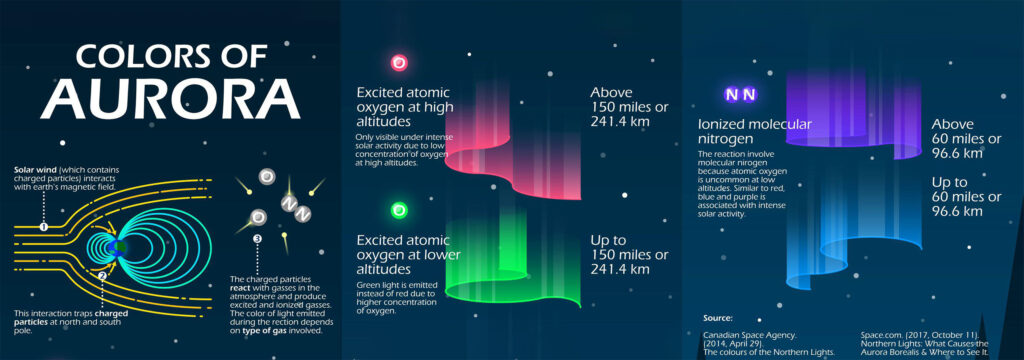
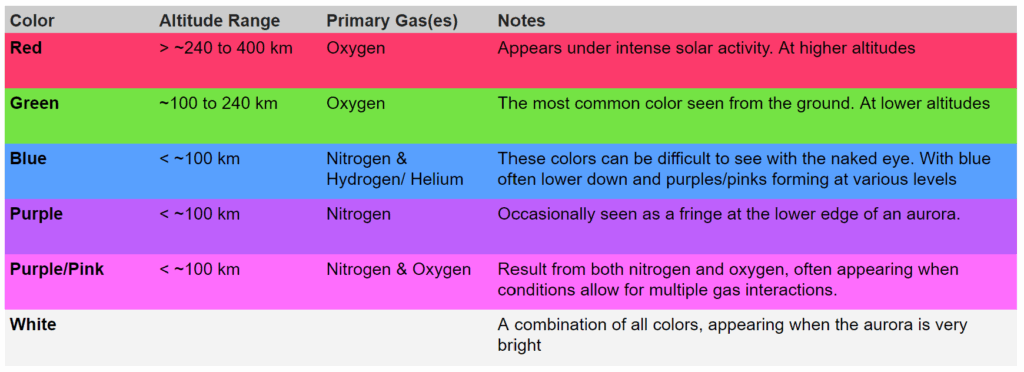
Aurora colours vary (red, green, purple) depending on which atmospheric gas (oxygen or nitrogen) is hit by solar particles and at what altitude, with green being most common from oxygen at lower levels, red from oxygen higher up, and blue/purple from nitrogen, often appearing when solar activity is strong.
Why Colours Differ
- Gas Type: Oxygen emits green/red; Nitrogen emits blue/purple/pink.
- Altitude: Different gases are prevalent at different heights, and particle energy levels change with altitude, affecting light emission.
- Solar Activity: Stronger solar storms excite more gases, allowing rarer colours like red and blue to become visible.
References
https://www.swpc.noaa.gov/content/aurora-tutorial
https://www.mprnews.org/story/2024/10/11/understanding-aurora-colors-the-science-behind-the-display
https://www.spaceweatherlive.com/en/help/the-kp-index.html
https://www.timeanddate.com/news/astronomy/solar-maximum-aurora-colors
https://icelandatnight.is/bz-level